Dentures Are Not One Size Fits All
Today, "dentures" covers a wide range of options. Some rest on the gums and are removed each night. Others click onto dental implants for extra stability. Others are fixed in place and are only removed by your dentist.
At Luminous Dentistry in Wakefield, MA, we start with how you eat, speak and smile, then look at your gum health, bone support and the teeth you still have. From there we explain the options that fit your situation and the trade-offs of each, so you can decide with clear information.
Our practice has a prosthodontic focus, which means we think about how teeth, gums, bite and facial support work together before we recommend a restoration.
Types of Dentures We Can Talk Through
Which one is right depends on your bone, your remaining teeth, your health and what you want from your smile.
Complete Dentures
A full set of custom teeth that replaces an entire upper or lower arch. Made after your gums have healed from any extractions, and designed to restore chewing, speech and facial support.
Partial Dentures
Replace one or several missing teeth while keeping the natural teeth you have. A partial anchors to remaining teeth, fills the gaps and helps stop neighboring teeth from drifting.
Snap-In Implant Dentures
A removable denture that clicks onto a small number of dental implants. Far more stable than a conventional denture, and easy to take out for cleaning.
Fixed Full-Arch Teeth
A full arch of teeth secured to dental implants and not removed by the patient. Often called permanent dentures, this is the All-on-X approach.
About All-on-XTraditional vs. Implant-Supported Dentures
Implant-supported dentures anchor to the jaw, while regular dentures rest on the gums. Here is how the main options differ day to day.
| Traditional Dentures | Snap-In Implant Dentures | Fixed Full-Arch | |
|---|---|---|---|
| How it is held | Rests on the gums, with suction or adhesive | Clicks onto 2 to 4 implants | Screwed to implants and fixed in place |
| Removable? | Yes, daily | Yes, usually removed nightly | No, removed only by your dentist |
| Upper palate | Usually covered | Often left open | Left open |
| Jawbone support | Does not stimulate bone | Implants help preserve bone where they sit | Implants help preserve bone |
| Stability when eating | Can shift or loosen | Much more secure | Closest to natural teeth |
| Upkeep | Relines and adjustments as the gums change | Periodic replacement of attachments | Daily hygiene and regular professional visits |
| Surgery needed | No | Yes, minor | Yes, with a healing period |
Every case is different. Your exam and imaging decide what is a safe and realistic option for you.
Digitally Planned, Prosthodontically Guided
A denture only works when it fits the mouth it lives in. We plan with the same digital tools we use for implant surgery and restorative cases.
3D Imaging
KaVo OP 3D imaging shows bone, sinus and nerve positions, so options like implant-retained dentures are planned on real anatomy.
Digital Design
Digital scans and planning help us design tooth position, bite and smile line before your restoration is made.
In-House Digital Lab
Our on-site digital lab supports precise fabrication and faster adjustments when something needs refining.
Comfort Options
Sedation options are available for patients who need extractions or implant placement and want a calmer visit.
Partial Dentures and the Alternatives
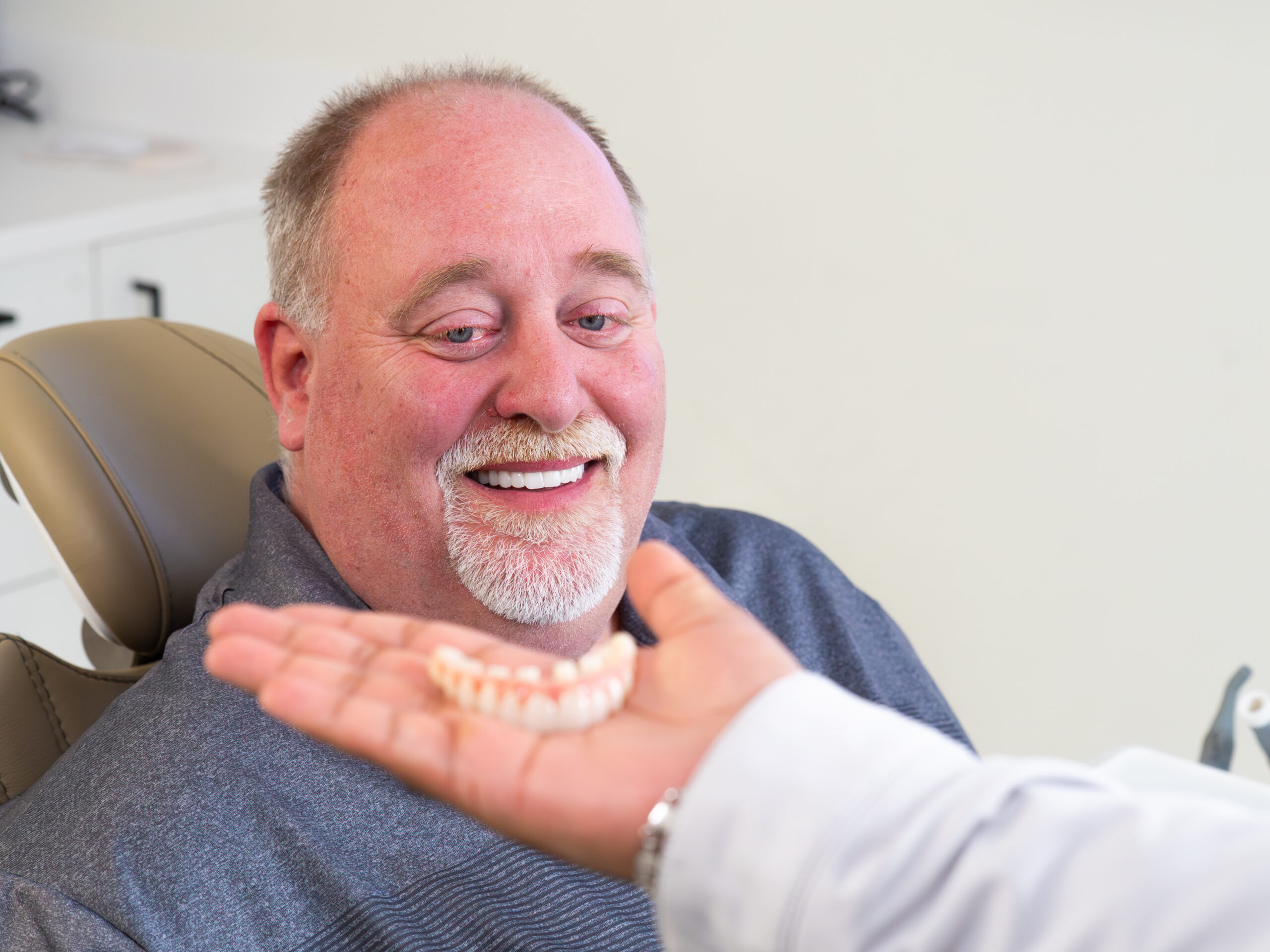
If you still have healthy natural teeth, a partial denture can replace the missing ones without replacing the whole arch. It uses clasps or precision attachments on your remaining teeth to hold it steady.
- Cast metal partials: a thin, rigid framework with resin teeth
- Acrylic partials: a pink acrylic base with replacement teeth attached
- Flexible partials: a thin thermoplastic base with no metal clasps
A partial is not the only way to fill gaps. Depending on your teeth and bone, a fixed bridge or dental implants may be worth discussing too.
Who Should Consider Implant-Supported Dentures?
Implant-supported options are worth exploring if any of these sound familiar:
- Your current denture slips, clicks or rubs when you eat or speak
- You avoid foods you enjoy because of how your denture feels
- You rely on adhesive to feel secure
- You are missing most or all of your teeth, or your remaining teeth are failing
- You want to slow the bone loss that follows tooth loss
You need healthy gum tissue and enough jawbone to hold implants. If bone has thinned, a graft may be discussed first. Implant surgery does involve a healing period before the final teeth are attached, and your doctor will walk you through that timeline.
Start With a Consultation
We review your history, examine your gums and bite, take imaging and talk through the denture options that realistically suit you. Every job is quoted after inspection, contact us for a quote.
Not sure whether you need dentures at all? That is a good question to bring to your visit.
Book a Consultation Call (781) 587-2605Your Denture Journey at Luminous Dentistry
From the first conversation to the final adjustment, here is how the process usually unfolds.
Exam and Imaging
We examine your gums, teeth and bite and take the imaging needed to see bone and anatomy.
Plan Your Options
We explain which denture types suit you, whether implants make sense and what each path involves.
Preparation
If teeth need to be removed or implants placed, we plan that stage with comfort options available.
Fit and Follow-Up
Your restoration is fitted, checked for bite and comfort, and adjusted as you settle in.
Related Services
Dentures often connect to other treatment. These pages cover the next questions patients ask.
All-on-X Implants
A fixed full-arch alternative to removable dentures, supported by 4 to 6 implants.
Dental Implants
Single implants, implant bridges and the complete overview of implant options.
Crowns vs. Bridges
How fixed bridges compare with crowns when you are replacing a missing tooth.
Sedation Dentistry
Comfort options for extractions, implant surgery and anxious patients.
Dentures in Wakefield FAQs
"Permanent" usually means one of three things. Traditional dentures are custom removable teeth that rest on the gums. Snap-in implant dentures are removable but click onto 2 to 4 implants for stability. Fixed full-arch restorations, such as All-on-X, are screwed onto implants and are removed only by your dentist.
Implant-supported dentures anchor to titanium posts in the jawbone, while regular dentures rest on the gums. Because of that, implant-supported options are more stable, usually need less adhesive and help preserve jawbone where the implants sit. They do involve a minor surgical step and a healing period.
The implants themselves are designed to last many years, often a lifetime with good care. The denture teeth or prosthetic wear with daily use and typically need repair or replacement over time. Good hygiene, regular checkups and managing habits like grinding all help longevity.
It depends on the type. Fixed implant-supported teeth stay in around the clock. Removable dentures, including snap-in implant dentures and partial dentures, are generally taken out at night so your gums can rest and the appliance can be cleaned.
The main trade-offs are the surgical step, the healing time needed for implants to bond with the bone and the possibility of bone grafting if the jaw has thinned. Every job is quoted after inspection, contact us for a quote, and we explain the full timeline before you decide.
There is no strict number. A partial denture needs healthy natural teeth to anchor to, and what matters is how strong and well placed those teeth are. If no natural teeth remain, a complete denture or an implant-based option is usually considered.
Very sticky foods like caramel and gum can loosen a denture, and small seeds or popcorn hulls can get under it. Hard raw produce and tough meats may need to be cut small, cooked longer or chewed slowly. Most people can enjoy a wide range of foods once they have adjusted, and implant-supported options give more confidence.
Ready to talk about your smile?
Book Your ConsultationServing patients in Wakefield, Lynnfield, Reading, Stoneham, Malden and nearby North Shore communities.