
Crowns vs. Bridges — Why It Matters
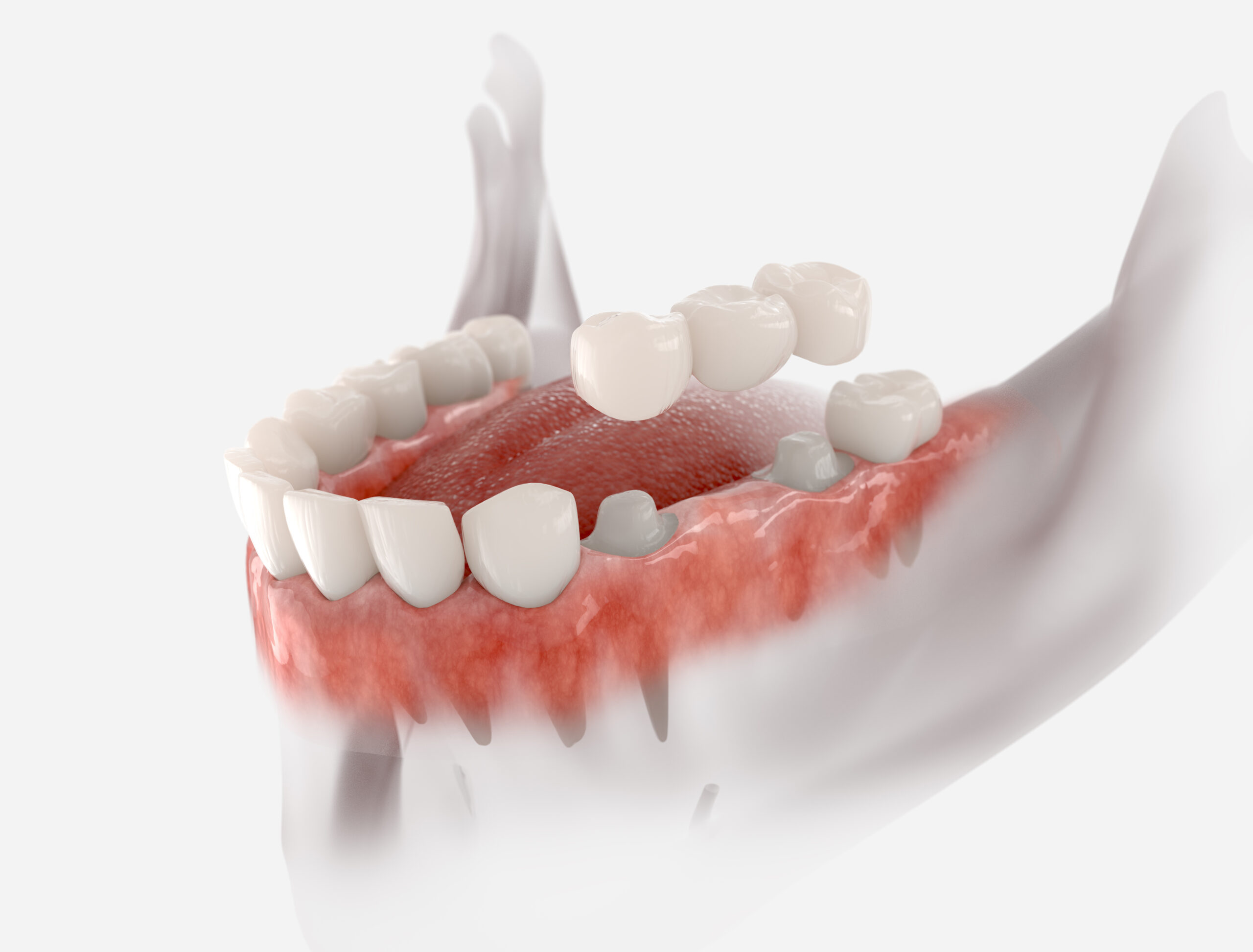
Dental crowns and dental bridges are both fixed restorations — meaning they are cemented in place and not removed daily like dentures. But they solve different problems. A crown restores a single damaged tooth. A bridge replaces one or more missing teeth by spanning the gap between adjacent teeth.
Understanding the difference helps you walk into your consultation at Luminous Dentistry in Wakefield, MA knowing what questions to ask and what to expect. Our team uses digital planning and an on-site lab to deliver both treatments with precision and speed.
What Are Crowns and What Are Bridges?
Before comparing, it helps to understand what each restoration does and the clinical problem it is designed to solve.
Dental Crowns
Restore. Protect. Strengthen.
A dental crown is a custom cap that covers the entire visible portion of a single tooth above the gumline. It restores the tooth's shape, strength, size, and appearance when the natural structure has been compromised by decay, fracture, or root canal treatment.
- Covers and protects one existing tooth
- Requires the damaged tooth to still be present
- Restores full chewing function and biting strength
- Used after root canals, severe decay, or fractures
- Also used to cap dental implants
- Lasts 10–30 years with proper care
Dental Bridges
Replace. Fill Gaps. Restore Function.
A dental bridge replaces one or more missing teeth by anchoring a false tooth (or pontic) to the natural teeth on either side of the gap. The adjacent teeth are prepared with crowns that support the bridge structure, filling the space left by the missing tooth.
- Replaces one or more missing teeth
- Anchors to adjacent healthy teeth (abutments)
- Adjacent teeth require enamel reduction for crown placement
- Restores chewing ability, speech, and facial structure
- Fixed in place — not removable like dentures
- Lasts 10–15+ years with proper care
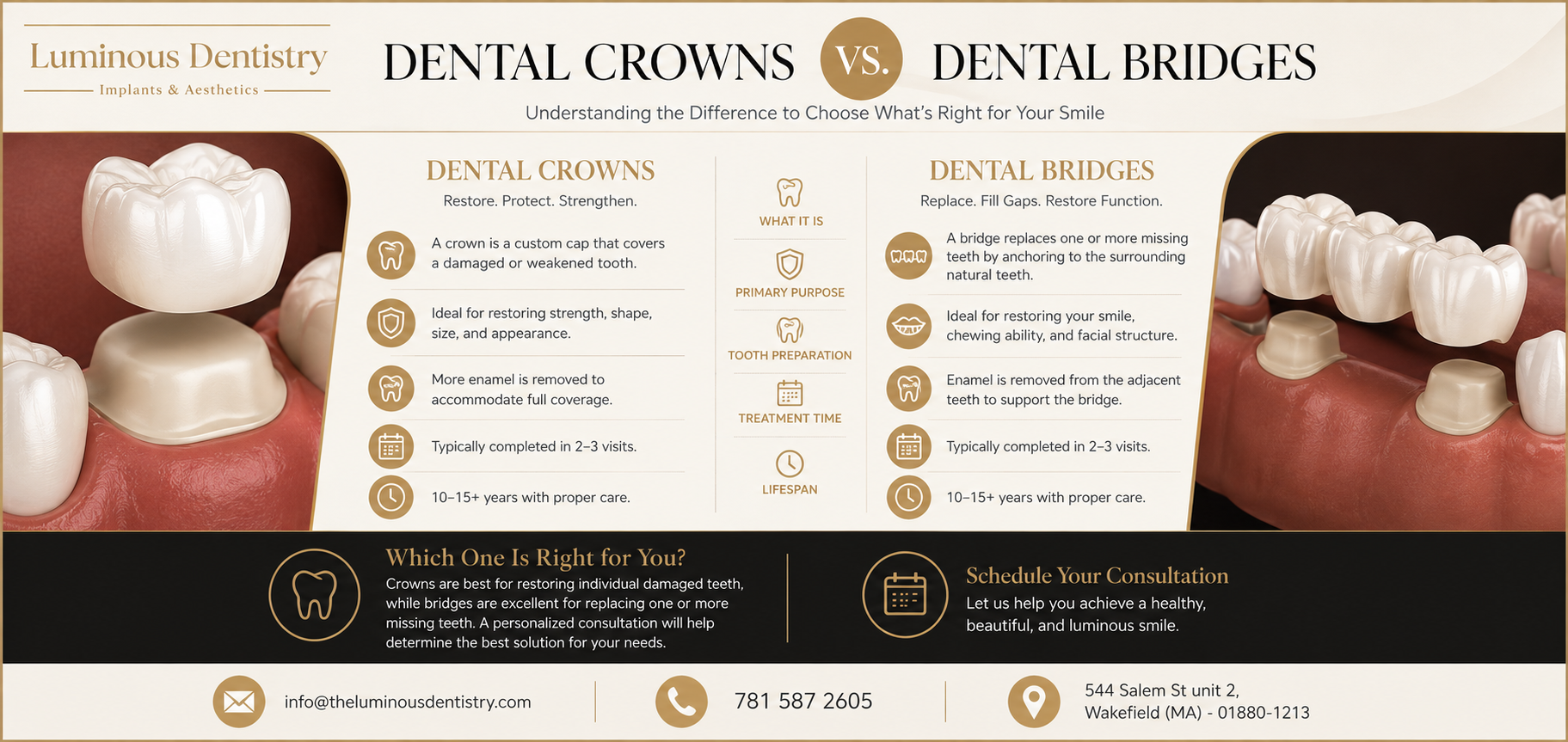
Dental Crowns vs. Dental Bridges at a Glance
Use this comparison to understand the key clinical differences before your consultation at Luminous Dentistry in Wakefield, MA.
When Should You Choose a Crown vs. a Bridge?
The right choice depends on whether you have a damaged tooth that still exists in the mouth or a gap where a tooth is missing entirely.
Choose a Crown When...
- Your tooth is severely decayed but the root is still intact
- Your tooth is cracked, fractured, or broken
- You have just completed root canal treatment
- A large filling has weakened the remaining tooth walls
- You need to restore full biting and chewing function
- You are completing a dental implant restoration
Choose a Bridge When...
- You are missing one or more teeth with a gap in your smile
- The adjacent teeth on either side are healthy and strong
- You want a fixed, non-removable tooth replacement
- You are not a candidate for dental implants at this time
- You want to restore chewing ability and smile appearance
- You want to prevent remaining teeth from shifting
Why Many Patients Choose Implants Over Bridges
A traditional dental bridge requires reshaping and placing crowns on the two healthy teeth adjacent to the gap — even if those teeth have no damage. This permanent alteration to healthy teeth is one of the key reasons many patients and dentists now prefer implant-supported restorations.
A dental implant replaces the missing tooth root directly into the jawbone and is topped with a single crown — with no impact on the surrounding teeth. Implants also preserve jawbone density, which bridges do not.
At Luminous Dentistry, our team will present all three options — crown, bridge, and implant — and help you understand the long-term pros and cons of each based on your specific clinical situation.
Learn About ImplantsThe Luminous Advantage
Whether you need a crown, bridge, or implant, Luminous Dentistry designs and fabricates all restorations in our on-site digital laboratory — no outside lab, no waiting weeks.
Our team uses 3D digital imaging and CAD/CAM milling to deliver restorations that fit precisely, match your natural tooth shade, and are ready faster than traditional workflows.
We also offer robotic-guided implant surgery and IV sedation for patients who need complex restorations done comfortably in fewer appointments.
Book a ConsultationCrowns vs. Bridges FAQs
A dental crown covers and protects a single existing damaged tooth. A dental bridge replaces one or more missing teeth by anchoring a false tooth to the healthy teeth on either side of the gap. Both are fixed, cemented restorations — but they solve different clinical problems.
They are not interchangeable — each is designed for a different situation. A crown is used when a damaged tooth is still present. A bridge is used when a tooth is missing. If a tooth is missing and the adjacent teeth are healthy, many dentists now recommend a dental implant over a bridge to avoid altering the healthy surrounding teeth.
Yes. A traditional dental bridge requires preparing the teeth on both sides of the gap by reshaping them and placing crowns on each. These adjacent teeth serve as anchors for the bridge. This is one reason many patients opt for a dental implant instead — an implant replaces the missing tooth without affecting the surrounding teeth.
Dental crowns typically last 10 to 30 years depending on the material and the forces placed on the tooth. Dental bridges generally last 10 to 15 years with proper care. Both require good oral hygiene, regular dental checkups, and avoiding habits like grinding teeth or biting into very hard foods.
Yes. A dental implant is often considered the most preferred long-term solution for replacing a missing tooth. It is placed directly into the jawbone and topped with a single crown — with no alteration to the adjacent teeth. Implants also preserve jawbone density, which a bridge does not. At Luminous Dentistry, our team will discuss whether an implant, bridge, or other option is best for your specific situation.
Many dental insurance plans provide partial coverage for dental bridges when they are deemed clinically necessary to replace missing teeth. Coverage typically falls under major restorative benefits and varies by plan. Dental crowns used to anchor the bridge may also receive partial coverage. Our team can help you review your benefits before treatment begins.
Both procedures are performed under local anesthetic, so patients feel pressure but not pain during tooth preparation. Some sensitivity or mild discomfort around the treated area is normal for a few days after the appointment. Sedation options are available at Luminous Dentistry for patients who prefer additional comfort during treatment.
Traditional crown and bridge procedures typically require two appointments — one for tooth preparation and impressions, and a second to place the final restoration. At Luminous Dentistry, our on-site digital laboratory significantly reduces the turnaround time between appointments, meaning your crown or bridge can be completed faster than practices that rely on outside labs.
Not sure which restoration is right for you?
Book a Consultation in Wakefield