
Veneers vs. Crowns — Why It Matters
Porcelain veneers and dental crowns are both custom-crafted restorations that improve the appearance of your smile — but they serve very different clinical purposes, require different amounts of tooth preparation, and are recommended for different situations.
Choosing the wrong treatment can mean unnecessary tooth reduction, a restoration that doesn't last, or an outcome that doesn't match your goals. At Luminous Dentistry in Wakefield, MA, our team uses digital smile analysis and personalized consultations to help you make the right decision — before any preparation begins.
This guide breaks down the key differences so you can walk into your consultation informed and confident.
What Are Veneers and What Are Crowns?
Before comparing the two, it helps to understand exactly what each restoration is and what it is designed to do.
Porcelain Veneers
Thin. Natural. Cosmetic.
A porcelain veneer is an ultra-thin, custom-made shell — approximately 1mm thick — that bonds to the front surface of a tooth. It does not wrap around the tooth or provide structural support. Veneers are a cosmetic treatment designed to correct the appearance of teeth that are otherwise structurally sound.
- Covers front surface only
- Minimal enamel removal required
- Best for cosmetic concerns — stains, chips, gaps, minor misalignment
- Lasts 10–15+ years with proper care
- Not suitable for structurally damaged teeth
Dental Crowns
Full Coverage. Protective. Restorative.
A dental crown is a custom cap — approximately 2mm thick — that encases the entire visible tooth above the gumline. Crowns restore the shape, strength, and function of a tooth that has been significantly damaged by decay, fracture, or root canal treatment.
- Covers the entire tooth — all surfaces
- Requires more enamel reduction
- Best for structural damage, decay, fracture, or post-root canal
- Lasts 10–30 years depending on material
- Handles heavy bite forces on back teeth
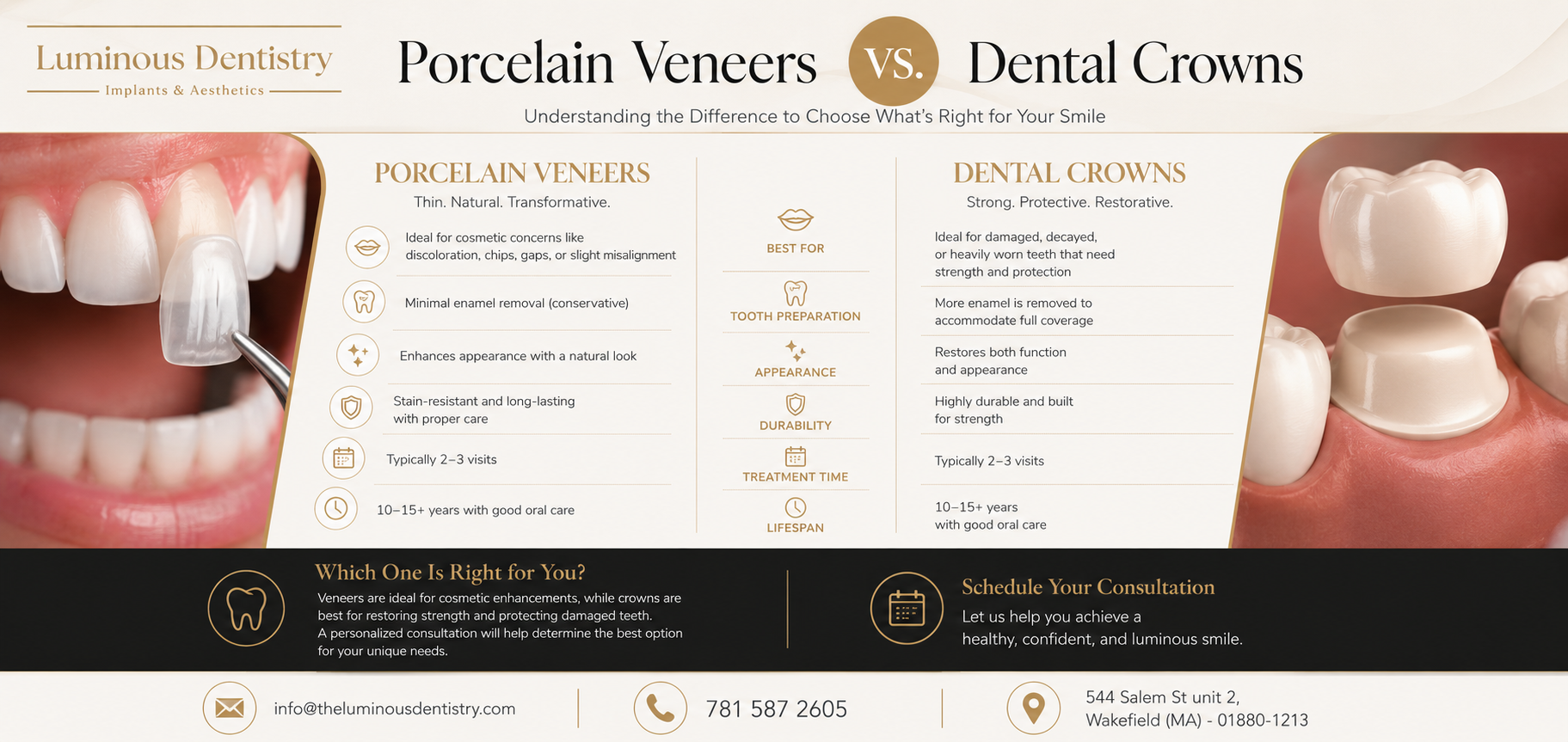
Porcelain Veneers vs. Dental Crowns at a Glance
Use this comparison to understand the key clinical differences before your consultation.
When Should You Choose Veneers vs. Crowns?
The right treatment depends on the condition of your tooth, your goals, and how much of the natural structure needs to be preserved or protected.
Choose Veneers When...
- Your tooth is structurally healthy and intact
- You want to correct staining that whitening cannot fix
- You have minor chips, worn edges, or small gaps
- You want a cosmetic smile makeover on front teeth
- You prefer a minimally invasive approach
- You do not grind your teeth heavily
Choose Crowns When...
- Your tooth is severely decayed, cracked, or fractured
- The tooth has had a root canal and needs protection
- A large existing filling has weakened the remaining tooth
- You need to restore full chewing function on a back tooth
- The tooth needs full structural coverage and strength
- You are restoring a tooth supported by a dental implant
How We Help You Choose at Luminous Dentistry
Every smile is different. The decision between veneers and crowns is not always straightforward — some teeth may appear to need a veneer but actually require a crown for structural reasons, and vice versa. At Luminous Dentistry in Wakefield, MA, we use digital smile analysis and 3D imaging to evaluate every tooth before recommending any treatment.
You will never be pushed toward the more expensive option. Our team recommends the most conservative treatment that achieves your goals — and with our on-site digital laboratory, both veneers and crowns are designed and fabricated in-house for a precise fit and faster delivery.
Digital Smile Analysis
We evaluate your teeth digitally before recommending veneers or crowns — so the treatment plan matches your actual clinical needs.
Mock-Up Previews
See a digital preview of your result before any enamel is touched. Know exactly what your smile will look like before you commit.
In-House Digital Lab
Both veneers and crowns are designed and milled on-site. Faster turnaround, better shade matching, no outside lab delays.
Same-Week Results
Our CAD/CAM technology means many cases are completed in just two appointments — often within the same week.
Veneers vs. Crowns FAQs
Neither is universally better — it depends entirely on the condition of your tooth and your goals. Veneers are the right choice when a tooth is structurally healthy and you want cosmetic improvement. Crowns are necessary when a tooth is severely damaged, decayed, weakened, or has undergone a root canal and needs full structural protection. Your dentist will evaluate the tooth and recommend the most appropriate treatment.
Yes. Crowns cover the entire tooth including the back and sides, while veneers only cover the front surface. Any dentist examining your teeth can easily identify which type of restoration is present. Both are custom-made and designed to look natural, but they are clinically distinct restorations with different preparation requirements.
Traditional veneers require removing a thin layer of enamel from the front of the tooth — typically less than 1mm. This process is permanent and the tooth will always require coverage going forward. However, the underlying tooth structure, nerve, and roots remain intact and healthy. Veneers are considered a safe, conservative treatment when placed by an experienced dentist on suitable candidates.
Dentists may advise against veneers if a patient has active gum disease, insufficient enamel to bond the veneer, severe bite misalignment, or a heavy teeth-grinding habit (bruxism). Because enamel removal is permanent, it is important that the tooth is in good health before proceeding. In some cases, a crown or other treatment is the more appropriate and durable solution.
Yes. Many patients combine veneers and crowns in the same treatment plan to achieve both aesthetic and restorative goals. For example, front teeth with cosmetic concerns may receive veneers while back teeth with structural damage receive crowns. At Luminous Dentistry, our team can coordinate a full smile plan using both treatments as needed.
Porcelain veneers typically last 10 to 15 years with proper oral hygiene and care. Dental crowns generally last 10 to 30 years depending on the material used and the forces placed on the tooth. Both can last longer with regular dental checkups, good brushing and flossing habits, and avoiding biting into very hard foods.
Porcelain veneers are considered cosmetic procedures and are typically not covered by dental insurance. Dental crowns may receive partial insurance coverage when they are deemed clinically necessary — such as after a root canal or to restore a severely damaged tooth. Our team can help you review your coverage options before treatment begins.
Celebrities most commonly get porcelain veneers to achieve a bright, symmetrical, and uniform smile — particularly for cosmetic corrections on front teeth. However, crowns may also be used when a specific tooth is damaged or has been treated with a root canal. The two treatments are often combined for comprehensive smile transformations.
Not sure which is right for your smile?
Book a Consultation in Wakefield